
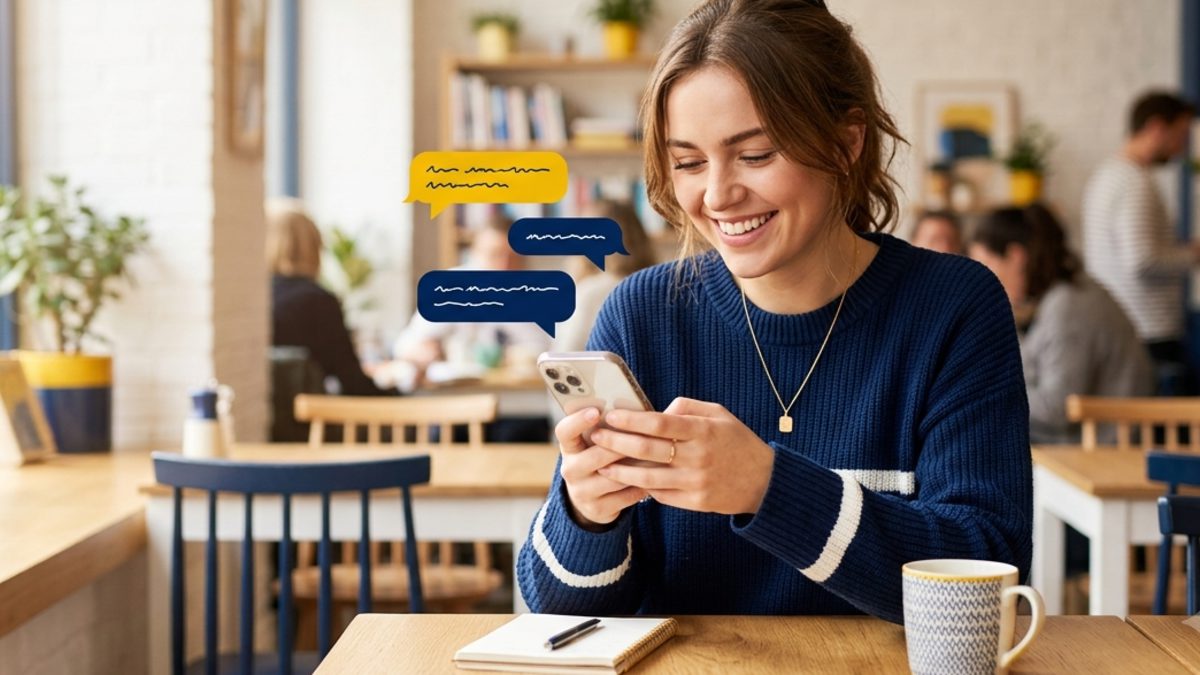
For a long time, business SMS only worked one way: the company sends, the customer reads. Appointment confirmations, promotions, delivery notices… replying was impossible, or went to a number that led nowhere.
Conversational SMS changes that. Customers can text the business and get a reply, by SMS, just as they would with a friend. Here is what this channel covers, what it is used for and how to set it up.
What is conversational SMS?
Conversational SMS is a two-way exchange of text messages between a business and its customers. The customer sends a question from their phone’s messaging app; an agent (or a tool) replies from a web interface, using the same number.
What sets it apart from standard SMS:
- a number you can reply to, instead of a sender name that receives nothing;
- a conversation thread: the question, the answer and what follows stay together;
- team handling: several agents can manage conversations from the same tool.
The customer has nothing to install: they use their phone’s SMS messaging, which works on every mobile, without an internet connection or an account to create.
Why your customers prefer to text
Calling customer service takes time: waiting, being available at the right moment, sometimes calling back. Many customers now prefer to write when they can and receive the answer later, without staying on the line.
SMS also has an advantage over messaging apps: it is universal. All your customers have it, whatever their age or phone, and check it every day.
Conversational SMS use cases
Conversational SMS fits many sectors:
- Retail: « Is the jacket available in size M in your shop? » The answer arrives in minutes, and so does the sale.
- Health, beauty, home services: moving or cancelling an appointment by SMS, with no call and no overloaded front desk.
- Delivery: changing a time slot, giving an access code or leaving the parcel with a neighbour.
- Automotive: « Is my car ready? » The garage replies without interrupting the workshop.
- Real estate: arranging a viewing, answering questions about a property.
- Hotels and restaurants: bookings, special requests, practical information before arrival.
- After-sales: warranty questions, sending a photo of an invoice, following up a repair.
In each case, the SMS replaces a call that would have cost both sides time.
The benefits for your business
A better customer experience
Customers get an answer on the channel they use every day, without waiting on the phone. That convenience translates into satisfaction and loyalty.
Fewer calls, better handled
Simple requests (availability, opening hours, rescheduling) move to writing. Your teams reply between tasks and keep the phone for conversations that really need it.
More conversions
An unanswered question is often a lost sale. By replying quickly to « Is it available? » or « Do you deliver to my area? », you turn hesitation into a purchase.
A reliable, recognisable channel
With a dedicated number, your customers recognise your business from one message to the next. And because these exchanges are requested by the customer, conversational SMS doesn’t feel like advertising.
Conversational SMS, WhatsApp, RCS: what are the differences?
Messaging apps such as WhatsApp also offer conversations with businesses, but they require the customer to have installed the app and agreed to contact you there. RCS, the « rich » evolution of SMS, still depends on phones and operators.
Conversational SMS relies on universality: it works everywhere, immediately, with the messaging app already on every phone. It is often the simplest starting point, which you can later complement with other channels.
How to set up conversational SMS
In France, business conversational SMS relies on numbers dedicated to business communication. With Time2chat, SMS Reflex’s conversational SMS solution:
- you get a dedicated 09 number, from a range reserved for businesses and recognised by all four French national operators;
- your customers text you from their usual messaging app;
- your team replies from the SMS Reflex web interface, with the full conversation history.
Billing is per session: once the conversation is open, messages are unlimited for 24 hours. Developers can also read conversations and reply to them through the SMS API.
Best practice to get started
- Publicise the number wherever your customers look for you: website, email signature, shop window, order confirmation.
- Set a realistic response time and stick to it. A quick reply is what gives the channel its value.
- Prepare template answers for frequent questions, while keeping a human tone.
- State your opening hours in your first reply if your teams are not available around the clock.
- Respect privacy: don’t use a service conversation to send advertising afterwards without consent.
In summary
Conversational SMS turns text messaging into a real dialogue channel: your customers write when they want, you reply from a number they recognise, and everyone saves time. To see how it works and what it costs, visit the Time2chat page or request a demo.